Tiếng Việt
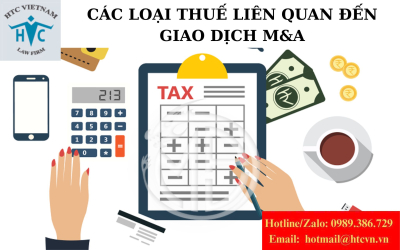
TYPES OF TAXES RELATED TO M&A TRANSACTIONS
Currently, M&A transactions in Vietnam are increasingly vibrant with numerous large deals. Learn about the types of taxes related to M&A transactions to optimize costs with HTC Vietnam Law Firm!
1. What is an M&A transaction?
M&A stands for "Merges and Acquisitions," which translates to "mergers and acquisitions." It is the activity of gaining control of a business through mergers or the acquisition of part or all of that business. According to the Vietnamese Enterprise Law, business mergers are regulated in Article 201, which stipulates that one or more companies may merge into another by transferring all assets, rights, obligations, and legal interests to the acquiring company, while simultaneously terminating the existence of the merged company.
This is a common strategy for companies to expand their market, increase economies of scale, or improve operational efficiency. In Vietnam, when conducting M&A, businesses need to understand the types of taxes related to M&A transactions to comply with legal regulations and avoid tax risks.
2. Types of taxes related to M&A transactions
In M&A transactions, businesses face many different types of taxes, depending on the form of the transaction such as the transfer of capital, assets, or projects. Below are the main types of taxes you need to know:
2.1. Personal Income Tax
Personal income tax applies to individuals with income from the transfer of capital (shares, equity stakes) or assets in M&A transactions.
Legal basis:
- Articles 3, 10, and 11 of the Personal Income Tax Law 2007 (amended and supplemented in 2012 and 2020).
- Circular 111/2013/TT-BTC guiding the implementation of personal income tax.
How to calculate tax:
- Transfer of shares and securities: Tax rate of 0.1% on the transaction value.
- Transfer of capital contributions in a limited liability company: Tax rate of 20% on taxable income (taxable income = Transfer price - Cost price).
Cases of tax exemption or reduction:
- Tax exemption applies to inheritances or gifts between parents and children, spouses, and grandparents and grandchildren.
- Double Taxation Avoidance Agreement: Individuals with income from M&A transactions between countries may be exempt from or receive a reduction in taxes if a double taxation avoidance agreement applies.
2.2. Corporate Income Tax (CIT)
Corporate income tax applies to businesses that generate income from the transfer of capital, assets, or projects in mergers and acquisitions (M&A). This is the primary tax for legal entities.
Legal basis:
- Articles 14, 15, and 16 of the Corporate Income Tax Law 2008 (amended and supplemented in 2013 and 2020).
- Decree 218/2013/ND-CP and Circular 78/2014/TT-BTC provide guidance on corporate income tax.
How to calculate tax:
- Taxable income = Transfer value - Purchase price - Transfer fees.
- Tax rate: 20% according to Vietnam's Corporate Income Tax Law.
Cases of tax exemption or reduction:
- Businesses within the same group may be exempt from tax when transferring assets, provided they meet the specified conditions.
- Businesses eligible for investment incentives may apply a preferential tax rate of 10% for 15 years or be exempt from tax for 4 years and receive a 50% tax reduction for the following 9 years, according to Article 13 of the Corporate Income Tax Law.
2.3. Value Added Tax (VAT)
VAT applies to transactions involving the transfer of assets or projects in M&A, but not to the transfer of capital.
Legal basis:
- Articles 5, 7, and 8 of the Value Added Tax Law 2008 (amended and supplemented in 2016 and 2022).
- Decree 209/2013/ND-CP and Circular 219/2013/TT-BTC guiding Value Added Tax.
Tax calculation method
- Tax rate: Usually 10%, but land use rights are exempt from VAT.
- VAT exemption for the transfer of land use rights (according to Article 4 of the VAT Law).
2.4. Other tax obligations
In addition to the main taxes mentioned above, businesses may also be subject to registration fees and tax obligations related to the termination of operations after an M&A transaction.
Legal basis:
- Decree 140/2016/ND-CP on registration fees.
- Articles 206 and 207 of the 2019 Tax Administration Law regarding the termination of business operations.
Applicable cases
- Registration fee: Applicable when re-registering ownership of property after a purchase transaction.
- Taxes related to cessation of operations: The merged company must fulfill its tax obligations to close its tax identification number.
Double Taxation Avoidance Agreement (DTA)
For M&A transactions involving foreign investors, double taxation avoidance agreements play a crucial role in reducing the tax burden.
Legal basis:
- Vietnam has signed more than 80 double taxation avoidance agreements with other countries.
These agreements are governed by the Corporate Income Tax Law, Personal Income Tax Law, and regulations of the Ministry of Finance.
Benefits of Double Taxation Avoidance Agreements (DTAs):
- If a foreign investor has already paid taxes in their home country, they may be exempt from taxes in Vietnam or be entitled to a tax deduction for the taxes already paid.
- Certain capital transfer transactions between internationally affiliated companies may be eligible for preferential tax rates or tax exemptions under agreements between the two countries.
3. M&A Tax Consulting Services at HTC Vietnam Law Firm
Understanding and complying with taxes related to M&A transactions requires in-depth knowledge. HTC Vietnam Law Firm provides professional consulting services:
- Tax obligation consulting: Analyzing the types of taxes applicable to each type of M&A.
- Assistance with tax filing and payment: Ensuring taxes are paid on time and in accordance with regulations.
- Legal representative: Works with tax authorities to handle any arising issues.
_______________________________________________
Commitment to service quality:
HTC Vietnam Law Firm operates with the motto of dedication – efficiency – credibility, and is committed to ensuring the quality of its services, specifically as follows:
- Ensure that work is completed according to the agreed schedule, in compliance with legal regulations, and in accordance with the code of ethics and conduct for Vietnamese lawyers.
- We prioritize customer interests and strive to provide our customers with the best possible service quality.
- Protect the information provided by customers and information related to them.
We look forward to a long-term partnership and mutual growth with our valued customers.
Best regards!
(Author: Nguyen Hoang Duong; Date: March 30, 2025)
For detailed advice, please contact us.
HTC Vietnam Law Firm
Address: 4th Floor, Multi-purpose Building, 169 Nguyen Ngoc Vu Street, Trung Hoa Ward, Cau Giay District, Hanoi City.
Phone: 0989.386.729
Email: hotmail@htcvn.vn
Website: https://htcvn.vn ; https://htc-law.com ; https://luatsuchoban.vn