Tiếng Việt

Conditions for adoption according to the latest regulations
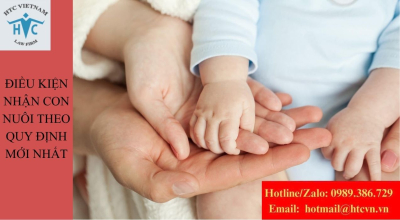
Child adoption conditions according to the latest regulations are an issue that many individuals and families are concerned about when they wish to adopt children as legal children. However, not everyone fully meets the conditions prescribed by law. So what standards do adopters need to meet? What cases are prohibited from adopting? The following article will fully update the conditions for adoption according to the latest regulations, helping you understand the law and avoid errors in the process of carrying out the procedure.
1. What is adoption?
According to Clause 1, Article 2 of the 2010 Law on Adoption, adoption is the establishment of a parent-child relationship between the adopter and the adoptee in accordance with the law. From the time the adoption is registered by a competent state agency, the adopter and the adopted child have full rights and obligations of the father, mother and child in accordance with the law on marriage and family as well as relevant legal provisions.
Adoption not only aims to ensure that children have a stable family environment, are cared for, nurtured and educated, but also meet the legitimate needs of individuals and husband and wife who wish to adopt children in accordance with the provisions of law.
2. Conditions for adoption
Pursuant to Article 14 of the Law on Adoption 2010, the conditions for adoption are as follows:
Conditions for adopters
- The adopter must fully meet the following conditions: Having full civil act capacity; More than the adopted child is 20 years old or older; Having health, economic and accommodation conditions to ensure the care, nurturing and education of adopted children; Have good moral character.
- The following persons are not allowed to adopt children: Some parental rights are restricted from their minor children; Serving administrative handling decisions at educational institutions or medical treatment establishments; Serving a prison sentence; Not yet having a criminal record expunged for one of the crimes of intentionally infringing upon the life, health, dignity and honor of others; abusing or torturing their grandparents, parents, spouses, children, grandchildren, or persons who have meritorious services to their upbringing; enticing, coercing or harboring minors to violate the law; buying, selling, exchanging and appropriating children.
- In case the stepfather adopts the stepchild of the wife or stepmother or adopts the stepchild of the husband or the biological aunt, uncle or uncle adopts the grandchild, the provisions at Points b and c, Clause 1 of this Article do not apply.
Regarding the adopted person:
- Children under 16 years old.
- Persons aged between full 16 and under 18 years old if they fall into one of the following cases: Adopted by stepfathers or stepmothers; Adopted by aunts, uncles, uncles, and uncles.
A person may only be adopted by a single person or by both spouses. The State encourages the adoption of orphans, abandoned children and children in other special circumstances.
In case of not having to meet the age and economic conditions
According to Clause 3, Article 14 of the 2010 Law on Adoption, in case a stepfather adopts a stepchild of his wife or stepmother or adopts a stepchild of his husband or an aunt, uncle or uncle adopts a grandchild, it is not required to meet the conditions of being more than 20 years old for adoption and health conditions. economy, accommodation.
3. Prohibited acts in child adoption.
Pursuant to the provisions of Article 13 of the Law on Adoption 2010, the prohibited acts in child adoption are as follows:
- Taking advantage of child adoption for self-seeking, labor exploitation, sexual abuse; kidnapping and trafficking of children.
- Forging documents to settle the adoption.
- Discrimination between natural and adopted children.
- Taking advantage of child adoption to violate the law on population.
- Taking advantage of the adoption of children of war invalids, people with meritorious services to the revolution, and people belonging to ethnic minorities to enjoy the State's preferential regimes and policies.
- Grandparents adopt grandchildren or brothers, sisters and sisters adopt each other.
- Taking advantage of child adoption to violate laws, customs, ethics and fine cultural traditions of the nation.
4. Adoption dossiers and procedures
4.1. Adoption dossiers for adopted persons
Children introduced for adoption or adoption must have all papers and dossiers, including:
- Birth certificate;
- Health examination certificate issued by a district-level or higher-level medical facility;
- Full-body photo, straight view (shooting time not more than 6 months);
- Papers and documents corresponding to the actual case of the child:
+ Abandoned children: Written certification of the People's Committee/police of the commune where the child was found;
+ Orphans: Death certificates of natural parents or documents of equivalent value;
+ Children whose natural parents are missing: The decision to declare the natural parents missing by the competent People's Court;
+ Children whose natural parents have lost their civil act capacity: The decision to declare the natural parents to have lost their civil act capacity by the competent People's Court.
- Decision on reception of children introduced for adoption at nurturing establishments.
4.2. Dossiers of application for adoption of children for adopters
To apply for adoption, the adopter must have all papers and dossiers including:
- An application for adoption;
- Personal legal documents: ID card/ID card/passport;
- Judicial record card;
- Certificate of marital status;
- Health examination certificate issued by a district-level or higher-level medical facility;
- A written certification of the People's Committee of the commune or place of permanent residence on the satisfaction of economic conditions and accommodation for child adoption.
4.3.Thcustomary adoption.
Procedures for adoption include:
Step 1: Prepare documents
Step 2: Prepare the dossier
Step 3: Give the adoption certificate
5. Why should you ask a lawyer for advice when adopting a child?
Although the adoption procedures are quite clearly stipulated by law, in fact, many cases still face difficulties due to not understanding the conditions, preparing incomplete documents or not understanding the correct order and procedures. Consulting a lawyer will help the adoption process take place smoothly, in accordance with regulations and limit unnecessary legal risks.
When using the consulting services of lawyers, you will receive support such as:
- Assessment of adoption conditions: Check whether the adopter and the adoptee meet the conditions under the Adoption Law.
- Consulting on documents and procedures: Guiding the preparation of all documents, identifying the right competent authority and the order of implementation in accordance with the provisions of law.
- Review and complete the dossier: Check the validity of the dossier, limit the need to amend, supplement or be rejected due to lack of documents.
- Assisting in resolving complex cases: Advising on cases of adoption of stepchildren of spouses, adoptions with foreign elements or situations arising from disputes and legal problems.
- Protecting the legitimate rights and interests of customers: Representing or assisting in working with competent authorities within the scope permitted by law, contributing to ensuring the interests of adopters and children.
Having a lawyer is not a mandatory condition for carrying out the adoption procedure. However, the support of a lawyer will help save time, limit errors in the process of preparing documents and increase the ability to complete procedures quickly and in accordance with the law.
Final Thoughts
Fully meeting the conditions for child adoption according to the latest regulations is an important factor for the adoption process to be carried out in accordance with the law and ensure the legitimate rights and interests of both adopters and children. In addition to meeting the conditions on the subject, the adopter also needs to prepare a full dossier, comply with the order and procedures as prescribed by law.
In case there are still problems about adoption conditions, documents, procedures or legal issues arising, consulting a lawyer will help you have an appropriate solution, limit risks and ensure that the adoption process takes place quickly. in accordance with regulations. If you need support, contact a lawyer or a reputable legal consultant for advice and accompaniment throughout the procedure.
__________________________________
Commitment to service quality:
HTC Vietnam Law Firm operates with the motto of dedication – efficiency – prestige, committed to ensuring service quality, specifically as follows:
- Ensure that the work is carried out according to the agreed schedule, ensure compliance with the law, in accordance with the code of ethics and conduct of Vietnamese lawyers.
- Put customer interests first, try our best to bring customers the best service quality.
- Confidentiality of information provided by customers, information related to customers.
We look forward to long-term cooperation with the development of our customers.
Best regards!
(Written by: Le Trang Nhung; Date written: 7/8/2026)
___________________________________
For detailed advice, please contact:
HTC Vietnam Law Firm
Address: 4th Floor, Multi-purpose Building, No. 169 Nguyen Ngoc Vu, Yen Hoa Ward, Hanoi City.
Phone: 0989.386.729Email: hotmail@htcvn.vn
Website:https://htcvn.vn; https://htc-law.com; https://luatsuchoban.vn